
AI Detects Concealed Car Damage That Fools Expert Human Inspectors
Sellers are experts at hiding problems. Discover how AI detects masterfully concealed car damage, like frame repairs and paintwork, that your eyes will miss.
AI-assisted research and drafting; factual sources are linked in the article.
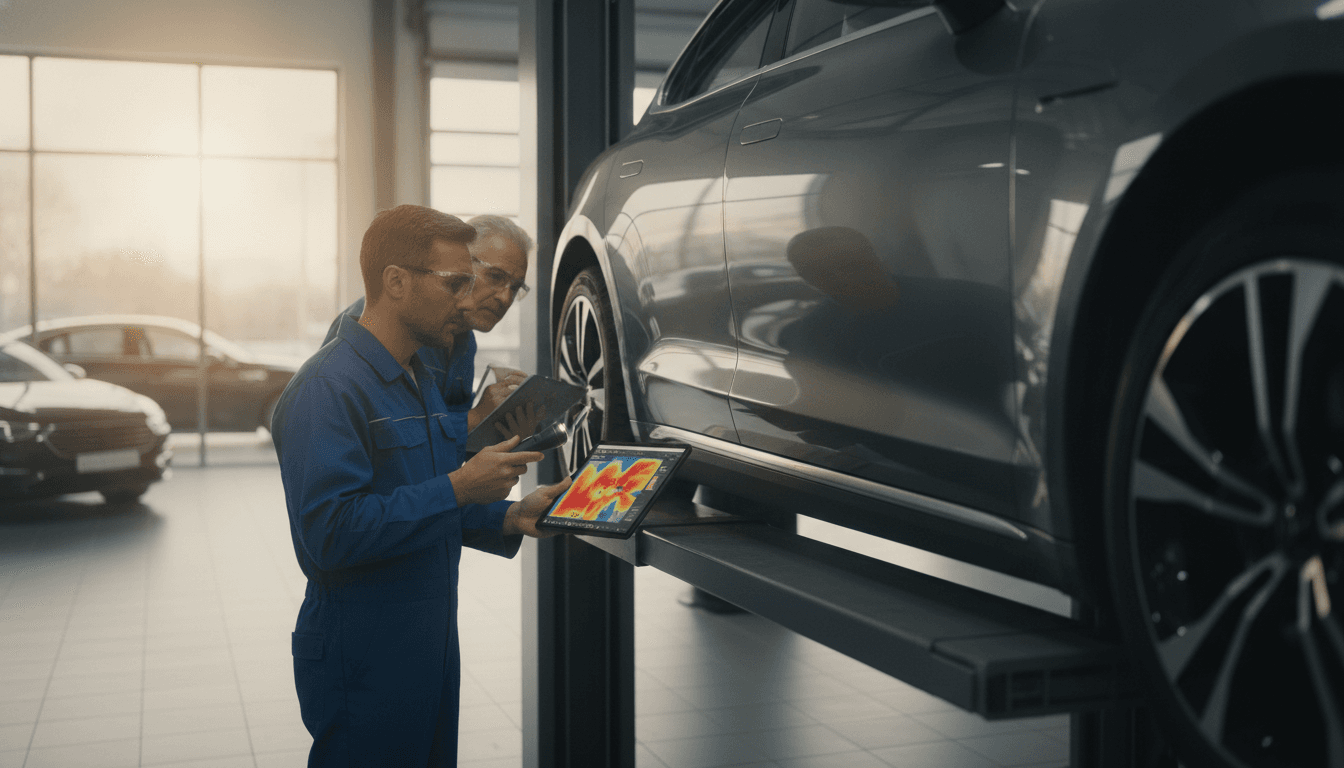
That Sinking Feeling: Is This Used Car Listing Too Good To Be True?
You’ve been scrolling for days. Marketplace, Autotrader, Craigslist—they all blur into one. Then you see it. The perfect 2019 Toyota RAV4. The color you want, the right mileage (45,000), and the price is just a little too perfect at $26,500. The photos are gorgeous, taken during that perfect sunset glow.
The seller says it has a clean title and no accidents. You feel that jolt of excitement. This could be the one.
But then, a knot forms in your stomach. We’ve all felt it. It’s the voice that whispers, “What am I missing?”
Ten years ago, you might have worried about a little rust or a small oil leak. Today, the game has changed. Sellers aren’t just hiding minor issues; they’re using professional-grade techniques to conceal major, deal-breaking problems. And frankly, the human eye is no longer equipped to win this game.
The Expert's Disguise: Why “Looks Good” Is a Dangerous Phrase
Let's be honest, you're smart. You know to check for the basics. You walk around the car, looking for mismatched paint, big dents, or uneven gaps between the doors and fenders. You might even bring a friend for a second opinion. But what if the person who fixed the car is better at hiding damage than you are at finding it?
Consider a common scenario: a 2018 Ford F-150 with a moderate front-end collision. The bumper, a headlight, and the front fender were damaged. A shoddy repair shop might slap some Bondo on it and use a cheap paint job you could spot from a mile away. But a masterful concealment is different.
- The Professional Fix: The shop orders a new OEM bumper. They source a used fender in the same color from a salvage yard. They use high-quality paint blended perfectly onto the adjacent door panel. The final bill for the owner, paid in cash to avoid an insurance report, is $3,500.
- The Result: To your eyes, the truck looks flawless. The panel gaps are tight. The paint seems to match perfectly under the dealership lights or in the seller's shady driveway.
But here’s what you can't see: the radiator support behind the bumper is still slightly bent, which will cause cooling issues in 6 months. The front frame horns, where the bumper mounts, were tweaked and pulled back, but not perfectly, leading to a lifetime of alignment problems and premature tire wear that will cost you $800 every 18 months.
This isn't a scare tactic; it's the reality of the modern used car market. The financial incentive to hide a $5,000 drop in value with a $2,000 cosmetic repair is just too strong.
The Subtle Clues Your Brain Is Trained to Ignore
Human eyes are amazing, but our brains are designed to see patterns and complete images. We subconsciously smooth over tiny imperfections. An AI sees only data. It isn't fooled by a good polish or a sunset photo.
Here’s what a visual AI analysis flags that you will almost certainly miss:
- Paint Texture Inconsistencies: Factory paint has a uniform, smooth application. A repainted panel, even a great one, almost always has a slightly different surface texture, often called “orange peel.” An AI can detect these microscopic differences in how light reflects off the surface, flagging a repainted panel that your eyes would swear is original.
- Pixel-Level Gap Analysis: You can use your finger or a credit card to check panel gaps, but a good body shop can get them to within a millimeter or two of factory spec. An AI measures the gap in pixels across the entire length of the panel. It can flag that the top of a door gap is 4mm while the bottom is 6mm—an undeniable sign that the door or fender has been refitted after a collision.
- Reflection Warping: This is a classic sign of body filler (Bondo). A straight line reflected across a panel, like a telephone pole or the edge of a building, should stay perfectly straight. If it wavers or distorts, even slightly, it means the panel underneath isn't flat. An AI can track these reflection lines with a precision the human eye simply can't match.
This is the new frontier where AI detects masterfully concealed car damage. It’s not about finding obvious dents; it’s about finding the ghosts of repairs past.
That “Clean” CarFax Report Is Not Your Safety Net
“But it has a clean CarFax!” This is one of the most dangerous phrases in used car buying.
Vehicle History Reports are a useful tool, but they are deeply flawed. They only report what has been reported to them. If someone gets into an accident and pays a local body shop cash to fix it, where does that report come from? It doesn't. The accident, in the eyes of the paperwork, never happened.
Here's a statistic that should worry you: Industry experts estimate that as many as 40% of all accidents are never reported to insurance or services like CarFax. On top of that, a 2021 study by vehicle market research firm Reaveal showed that 1 in 5 vehicles on the road have an open safety recall. The NHTSA website is your best friend here, but many sellers conveniently forget to check or disclose this.
Think about the 2007-2011 Toyota Camry 2.4L engine. It’s known for a serious oil consumption issue that often appears after 100,000 miles. It’s not an accident, so it won’t be on a history report. But it’s a potential $2,500 engine repair waiting to happen. The history report is silent. The visual evidence, however, is where the truth lies.
Case Study: The Nearly-Perfect 2020 Honda CR-V
Let's make this real. We recently analyzed a listing for a 2020 Honda CR-V with 38,000 miles. The asking price was $27,000, which is fair market value. The listing photos were crisp and clear. The CarFax was spotless. A prospective buyer was ready to drive two hours to see it.
Before they left, they ran the listing photos through CarScanAI. Here’s what it found:
- Mismatched Bumper Hardware: The AI flagged that the plastic clips holding the top of the front bumper cover were a slightly different shade of black and had different tooling marks than the factory originals visible in other photos of the same model year. This is something a human would never look for.
- Overspray on the Fender Liner: By zooming in and adjusting contrast on the photo of the front wheel, the AI identified microscopic flecks of silver paint on the black plastic fender liner. This is undeniable proof the front fender was repainted while on the vehicle.
- Headlight Date Codes: While not visible to the naked eye in the photo, our system cross-referenced the headlight's lens markings against a database. One headlight was from late 2019 (original), the other from mid-2021 (replacement).
The Verdict: This CR-V was in a front-end collision, significant enough to require a new bumper and headlight and a fender repaint. The repair was cosmetic perfection, but it concealed a history the seller was not disclosing. The true value of this vehicle was closer to $23,000, not $27,000. The buyer saved a four-hour round trip and avoided a $4,000 overpayment.
This is precisely how AI detects masterfully concealed car damage—by connecting dozens of tiny, almost invisible data points that, on their own, mean nothing, but together, tell a story the seller hoped you'd never hear.
Your Decision: Should You Trust Your Gut or Trust the Data?
The anxiety you feel when looking at a used car listing is valid. You're trying to protect yourself from a multi-thousand-dollar mistake. The problem is that the tools you've been taught to use—your own eyes and a simple history report—are becoming obsolete against the sophistication of modern repair and concealment techniques.
You can no longer afford to just ask, “Does it look okay?”
The right question to ask is, “What story are these photos really telling me?” The ability of AI detects masterfully concealed car damage isn't magic; it's just a new level of forensic analysis that is now available to you before you even get in your car to see a vehicle.
Before you get emotionally invested in a car that looks perfect online, before you waste an afternoon driving to see a car with a hidden history, take 60 seconds. Use the data that’s hiding in plain sight within the seller's own photos.
Found a listing that looks promising but feels a little too good? Screen the photos before you even message the seller. For less than the cost of the gas to go see it, you can get an unbiased, data-driven second opinion. It's the cheapest, fastest way to decide if a car is truly worth your time, or if you should just keep scrolling.
Have a listing in mind?
Run a free first-pass check using the year, make, model, mileage, and asking price. No account required.
Check a Listing FreeRelated Articles

Remote Used Car Inspection: AI Scan or Mechanic? Your Strategy Guide
Don't get burned on a remote car purchase. Learn a smart remote used car inspection strategy combining AI photo analysis for screening and a mechanic for validation.
Hidden Damage: How AI Spots What Used Car Sellers Conceal in 2026
Sellers use expert tactics to hide issues. Learn how AI detection of hidden used car damage concealment in 2026 unmasks these costly secrets before you buy.

AI Pre-Purchase Inspection: Is Your Used Car Hiding Secrets in 2026?
A traditional PPI isn't enough. Learn how an AI enhanced pre-purchase inspection for a used car in 2026 can uncover hidden damage and save you thousands.