
Don't Get Stuck: How to Spot Band-Aid Repairs on Used Cars
Sellers use cheap 'band-aid' repairs to hide costly problems. Learn the red flags and how AI is changing detecting band-aid repairs in used car inspection.
AI-assisted research and drafting; factual sources are linked in the article.
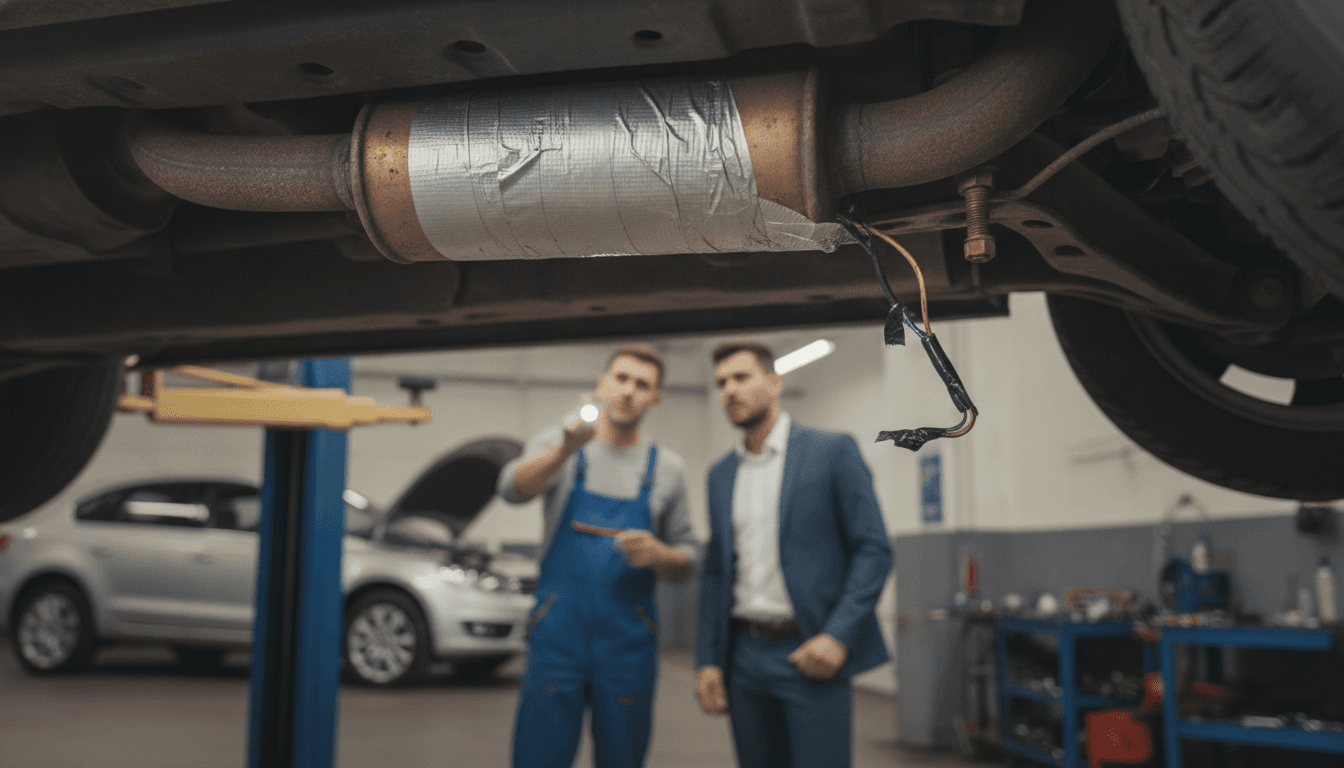
You’ve been scrolling for hours. Facebook Marketplace, Craigslist, Autotrader—they all start to blur together. Every listing promises a “reliable daily driver” or “mechanic-owned gem.” But in the back of your mind, a nagging question keeps you up at night: “Am I about to get ripped off?”
That fear is real. It’s the fear of buying someone else’s problem. The fear of that “great deal” turning into a $3,000 repair bill a month after you buy it. This isn't just about buying a car; it's about not making a catastrophic financial mistake.
And the biggest threat isn't the car with obvious problems. It’s the one with hidden problems, cleverly concealed under a layer of cheap, temporary fixes. We call them “band-aid repairs,” and they are the number one reason buyers get burned. This isn't just another checklist; this is your guide to detecting band-aid repairs used car inspection before you even waste gas driving to see a car.
The Anatomy of a Band-Aid Repair
A band-aid repair is a cheap, temporary fix designed to do one thing: get the car sold before the real problem rears its ugly head. It’s the automotive equivalent of painting over a crack in the wall. It looks fine for a little while, but the structural issue is still there, waiting to crumble.
I’ve seen hundreds of these in my career. Sellers, both private and sometimes even shady small dealers, are masters of disguise. Here are their favorite tricks:
The "Miracle-in-a-Bottle" Engine Fix
- The Band-Aid: A bottle of thick oil stabilizer or “engine honey” is poured into the crankcase. This thickens the oil to temporarily quiet a knocking rod, a noisy lifter, or reduce smoke from worn piston rings.
- The Real Problem: That knock isn’t just a noise; it’s the sound of your engine destroying itself from the inside. A full engine rebuild on a common vehicle like a Ford F-150 can easily cost $4,000-$7,000. That $15 bottle of additive is hiding a four-figure nightmare.
The "Black Paint" Rust Cure
- The Band-Aid: A fresh, thick coat of black undercoating or spray-on bed liner applied to the vehicle's frame and underbody.
- The Real Problem: This is often used to hide catastrophic frame rust. I see this constantly on trucks and SUVs from the Rust Belt. For example, 2005-2010 Toyota Tacomas were subject to a massive recall because their frames could rust through completely. A frame replacement can cost over $15,000—more than the truck is worth. Honest sellers will show you the clean frame; dishonest ones will hide it under a coat of fresh black paint.
The Cleared Check Engine Light
- The Band-Aid: The seller uses a cheap $20 OBD-II scanner to clear a check engine light moments before you arrive.
- The Real Problem: The light is off, but the underlying fault is still there. It could be a minor sensor, or it could be a failing catalytic converter. On a 2012 Toyota Prius, that’s a $2,500 repair. The light will stay off for 50-100 miles—just long enough for you to get it home and realize you’ve been had.
The Quick-Spray Paint Job
- The Band-Aid: A cheap, single-stage paint job to cover up collision damage on a fender or door.
- The Real Problem: The seller is hiding a previous accident. A high-quality repair from a reputable body shop can cost thousands and will be virtually undetectable. A cheap fix costs a few hundred bucks and often looks “good enough” in photos. But it can hide bent frame components, improper panel alignment, and future rust issues.
The Financial Ticking Time Bomb
These fixes turn a seemingly good deal into a money pit. Let’s run the numbers on a real-world scenario we analyzed recently.
The Car: A 2013 Ford Escape with the 1.6L EcoBoost engine, listed for $9,500. A pretty good price.
This specific engine has a well-documented history of coolant leaks that can lead to rapid overheating and catastrophic engine failure. The NHTSA has multiple investigations, including campaign number 17V209000, related to this issue. A responsible owner would have had the recall work done or the updated parts installed.
The Band-Aid: A dishonest seller knows this. They might see a small coolant leak. Instead of fixing it properly, they just keep topping off the coolant and cleaning the engine bay, hoping it won’t act up on your 15-minute test drive.
The Math of the Mistake: You buy the car for $9,500. Two months later, the engine overheats on the highway and seizes. Your mechanic quotes you $6,500 for a used replacement engine.
You didn't get a $9,500 car. You got a $16,000 car that's only worth $10,000 in perfect running condition. You’ve instantly lost $6,000 and inherited a massive headache.
The Human Eye vs. The AI Lens
“Okay,” you’re thinking, “I’ll just look for these things.”
But it’s not that simple. You’re standing in a stranger’s driveway, the lighting is weird, you’re trying to remember 50 different things to check, and you’re emotionally excited about your potential new car. You have “deal goggles” on. Sellers count on this.
This is where technology can be your unbiased co-pilot. An AI-powered inspection of listing photos, done from your couch, can spot things the human eye—especially an untrained, excited one—will miss.
- Detecting Paintwork: Your eyes might not notice that the front fender is slightly a different shade of silver than the door. But an AI can analyze the pixels, detecting minute variations in color, gloss, and texture. It can spot the tell-tale “orange peel” texture of a cheap repaint that your eyes would slide right over.
- Analyzing Panel Gaps: Is the gap between the hood and fender wider on one side? It could be a sign of a front-end collision where things weren't put back together to factory spec. An AI can measure these gaps in the photos and flag inconsistencies that suggest hidden damage.
- Spotting Hidden Dents: Sellers are experts at positioning cars to hide dents and dings in the shadows. By analyzing the consistency of reflections across body panels, AI can identify warped areas that indicate body filler or a repaired dent.
This isn't about replacing a mechanic. It's about not wasting your time or a mechanic's time on a car that's already waving red flags from the photos alone.
AI in Action: A Real-World Case Study
Let’s walk through a common scenario. You find a 2016 Subaru Outback on Facebook Marketplace. The price is good, the photos look clean, and the seller says it “runs great.”
The Old Way: You message the seller, arrange a time, drive 45 minutes across town, and spend 30 minutes looking it over. It seems okay, so you pay a mechanic $150 for a Pre-Purchase Inspection (PPI). The mechanic puts it on the lift and immediately says, “This thing has been hit in the front. The radiator support is bent, and this whole fender has been replaced and repainted poorly.” You just wasted 3 hours and $150 to find out what was hiding in plain sight.
The New Way: Before you even message the seller, you upload the listing photos to CarScanAI.
Within 60 seconds, you get a report:
- MODERATE RISK: Inconsistent panel gap detected between the hood and the passenger-side fender.
- MODERATE RISK: Paint texture inconsistency and reflection distortion noted on the passenger-side fender, indicating possible bodywork.
 (Note: a representative image would be here)
Now you have a decision to make, armed with objective data. You can either walk away instantly, saving you time and money, or you can approach the seller with specific questions: “The photos seem to show the fender gap is off. Has the car ever been in an accident?” Their answer—or their refusal to answer—tells you everything you need to know.
This is the power of a modern approach to detecting band-aid repairs used car inspection. You’re weeding out the bad apples before they ever cost you a dime or a minute of your time.
Your New Pre-Purchase Playbook
Stop thinking of a car purchase as a single event. Think of it as a funnel with three critical gates. Your job is to disqualify bad cars at each gate.
Gate 1: The 60-Second Digital Vetting
(Done from your phone before you even message the seller)
- AI Photo Analysis: Run the listing photos through CarScanAI. This is your first, fastest filter for hidden body damage.
- VIN Check: Ask for the VIN. Run it through the NHTSA website for free to check for unfixed safety recalls.
- Google the Guts: Search for “[Car Model] [Year] common problems.” Pay attention to forums where real owners complain. Are you seeing lots of posts about transmission failures around the mileage of the car you're considering? That's a red flag.
Gate 2: The In-Person Sensory Check
(Only if it passes Gate 1)
- Trust Your Gut: Does it smell like mildew (flood damage)? Does it smell like burning oil?
- Bring a Code Reader: A cheap OBD-II reader from Amazon costs $20. Plug it in. Even if the Check Engine light is off, you can go into the “I/M Readiness” menu. If it says “Monitors Not Ready,” it means the codes have been recently cleared. Walk away.
- Check the Fluids: Is the oil like molasses or is it so clean it looks like it was changed 5 minutes ago (to hide a leak)? Is the coolant bright and full?
Gate 3: The Professional Verdict
(The final boss. Only the best cars should make it here)
- The PPI: If a car passes the first two gates, it's time to invest $150-$250 in a Pre-Purchase Inspection from an independent mechanic you trust, not one the seller recommends. This is non-negotiable.
The AI scan in Gate 1 doesn't replace the PPI in Gate 3. It makes the entire process more efficient. It ensures you’re only spending that $150 on a car that has a real chance of being a winner.
Buying a used car is stressful enough. You don't need the added anxiety of wondering what expensive secrets a seller is hiding with a cheap can of spray paint or a bottle of thick oil.
You're scrolling through dozens of listings, trying to find 'the one.' Before you get your hopes up and drive across town, run the photos through a Quick Check. For less than the cost of a fancy coffee, you can get an instant, unbiased second opinion. It’s the smartest first step in weeding out the lemons and making sure your next car isn’t hiding a costly secret.
Have a listing in mind?
Run a free first-pass check using the year, make, model, mileage, and asking price. No account required.
Check a Listing FreeRelated Articles

AI Pre-Purchase Inspection: Is Your Used Car Hiding Secrets in 2026?
A traditional PPI isn't enough. Learn how an AI enhanced pre-purchase inspection for a used car in 2026 can uncover hidden damage and save you thousands.

The Silent Killers: 7 Hidden Used Car Problems Even Savvy Buyers Overlook (and How to Spot Them)
Don't get burned. We expose 7 hidden used car problems overlooked in a typical inspection that cost thousands. Learn to spot red flags before you buy.

The Ultimate AI-Powered Used Car Inspection Checklist 2026
Don't get ripped off in the 2026 market. Our AI-powered used car inspection checklist 2026 helps you spot hidden damage and avoid costly mistakes before you even see the car.